supported by an Artspace studio residency
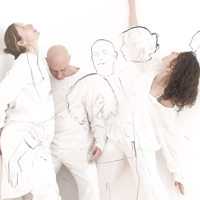
INTRODUCTION: An abstract play in twelve scenes (consisting of a fragmented text that investigates how integration or exclusion is felt around particular places in the outside world) by ART IN PROCESS is the basis for the development of a video & sound installation in private space. In Fool's Gold we used simple themes and directions to perform freely; and body movement and voice to experiment within this private space. Like in an "absurd fairytale" the two women experience their worlds that start to overlap, becoming one playground of existence.
The aspect of the nude body in Emotional Season_Fool's Gold: The human body is used as an expressive tool. It is used to express a full range of emotions and feelings to which the viewer can relate. The human form is part of the commonality, which holds the human race together. It is familiar to all people regardless of background, sex, education, culture, or ethnic identity. Thus, we used the human form in Fool's Gold to express universal truths and to address those ideas and concepts, which bind all human beings together. As a compositional element the body is viewed/used as a design form of shapes, highlights, and shadows within the studio setting of the abstract play.
THE TOPIC: The Woman talks to herself, but really to her inner being (personified by The Other Person), commented by The Narrator (a child's voice, associating the idea of the innocent being). In a so-called conversation one tries to talk the other into her lifestyle and way of thinking. But The Woman tries to get away from materialism and sees how the Western World has influenced her and how this concludes in the loss of her own identity. The Other Person still glorifies this world of western consumption. The woman tries to get back to her roots, tries to get rid of the unnecessary things we surround us with in our daily lives. Finally we see her world collapsing; all that is left is an irritated and confused human being. But then The Woman starts to feel the power of individuality.
CONTEXT of EMOTIONAL SEASONS project series 2010: Fool's Gold (developed in Sydney) is part of a bigger context of discovering different Emotional Seasons in Society and diverse cities/urban places. We generally address issues about identity and belonging arising from globalization and human existence in a cultural diverse society. What do we expect from our surroundings, from life in general? How much does materialism matter in diverse societies? How do identity and belonging reflect our true being away from materialism and mass consumption? How strong are we influenced by the materialistic world we live in? How does it feel to live in a foreign (cultural) living environment and how does this affect us personally? Which layers of reality do we create and inhabit?
ABOUT THE PERFORMERS
LENKA HUGHES
Lenka grew up in Sydney and is currently based out of Melbourne. She graduated from Deakin University in 2009 where she completed a Bachelor of Contemporary Arts with Distinction majoring in Dance and Photography. During her studies she has performed in works by Helena Yuk in Melbourne, New York choreographer Nicole Wolcott, while studying there on exchange, and her own piece as part of the inaugural Short, Sweet + Dance. Since graduation she has performed in Black Ocean and Examine 3.0 and has participated in the Soft Landing and Learning Curve mentorship programs.
ELISABETH M EITELBERGER
Elisabeth was born 1974 in Linz, Austria. She lives in Fremantle, Australia and Langenlois, Austria. Interested in the various aspects of artistic processes, she develops performances in public and private, writes absurd plays for video installations and engages in independent research about contemporary art in context to the work of ART IN PROCESS. After she had finished her studies of Philosophy, Art History and Theatre at the University of Vienna with a Master's degree in 1999, she worked at various cultural institutions in Austria. In 2000 she co-founded ART IN PROCESS with new media artist bello benischauer. She has worked independently ever since under this partnership; develops international projects and exhibitions and collaborations with artists from around the globe.
SYNOPSIS
an abstract play in twelve scenes by elisabeth m eitelberger
THE CHARACTERS
The Woman: Lenka Hughes
The Other Person: Elisabeth M Eitelberger
The Narrator (a five year old child): Elias Franz Benischauer
Scenery
The stage shows one room, covered by a front curtain that is transparent. The back wall is covered by a projection of an abstract moving image that changes with the scenes. In the room centre: a bed, covered by white sheets. You hear the sound of croaking frogs mixed with other sounds. The sound of croaking slowly disappears. Other sounds accompany the whole play through. The play begins.
01 Scene
The Woman lies on the bed. She starts to move. The Narrator from behind the scene begins to tell a story...
02 Scene
The Woman is gone. The Other Person appears on stage, lies again in the same bed, similar to The Woman, moves and seems to be suddenly scared by something and woken up. There is a transparent curtain in front of the bed. A projection onto the curtain shows the previous scene again: The Woman. The projected and the real scene overlap.

03 Scene
The scenery has changed. The Woman is gone. The projection on the back wall shows a drawing that can be associated with a forest. The way it looks like throws you into a fairy tale. You hear The Narrator's voice again, talking about The Woman. The Woman appears on stage from the left side, walks slowly across the stage, dream walking and yawning.
04 Scene
The Woman has disappeared from the stage. There is a projection onto the front curtain and the back wall, creating a dreamlike room with flowerlike pattern. The Woman and The Other Person appear both again on stage. They start talking to each other in an abstract conversation about their lives and how life treated them so far. The Woman complains about suffering from unhappiness because she missed out on glory and materialistic satisfaction, whereas The Other Person tells about her rich and luxurious life. The Woman considers to team up with The Other Person to have richer lives altogether. But when she listens to The Other Person's ideas about how to take over this world and to abuse their power to get their way, she turns away from her in disgust. Both disappear from the stage.

05 Scene
The Other Person kneels on the edge of the bed, holding onto a white plinth in front of her. The back wall projection shows a drawing of the same situation, slightly changing over time (A woman, kneeling in front of a mirror). The Other Person starts talking to what seems to be her own reflection. She talks about losing contact to her and how her way of living had influenced this relationship. She starts recognising that she seems to lose control of her own inner self. Finally she finds back to a peaceful and harmonious relationship between her mind and her body, struggling with existentialistic thoughts that still seem to occupy her brain.
06 Scene
Backdrop of Scene 03: the forest. The Woman appears from left, walks slowly and cautious across the stage.
She tries to reconnect with nature and accepts that materialism isn't necessary to understand life nor does it help her to find the right balance between her body and mind, and the outside world. Finally she gets aware of her own self.
07 Scene
Dreamlike scenery; abstract and painted backdrop showing city buildings.
The Woman and The Other Person face themselves and put generously red lipstick on each other's lips. Then they face the audience and stare into the distance.
Meanwhile you hear The Narrator's voice talking about them. Again making aware of the dangers of materialism. But also angry he comments that in trying to get away from each other's influence they had lost connection to each other over time and are now about to lose their whole identity.
08 Scene
Another scenery. The Woman appears as a shadow of herself. The Narrator's voice begins to talk about freedom and how a child would still be free from judging or picturing human existence.
The Woman and The Other Person appear both alternating, kneeling again on a plinth and stretching their arms, talking about how they finally manage to escape the materialistic world and its many influences.
They still struggle with generating the energy to set them free.
09 Scene
Same scenery. Both are facing each other and putting their hands together. They both speak in a chorus. They are ready now to face their individuality, which won't destroy their both identity. They are convinced to find a new perspective of facing this world with different eyes. There is nothing to be afraid of!
10 Scene
The Woman goes through stages of rebirth. She lies on a table, seems to have trouble moving. A bluish backdrop reminds of moving water, it reminds of amniotic fluid. It seems that the audience is witnessing her birth, making her way through the birth canal into the human world. Hanging on to her old self but already transforming into a different being.
11 Scene
Once again you see The Woman and The Other Person together on stage. The Other Person stands in the background and moves very slowly, whereas The Woman moves dancelike in the front. This movement - if you wish - could be associated with expulsive pains.
12 Scene
The Woman cries out like a newborn and sits up; there is the bed on the stage from the first scene. Alternating you see and hear both, The Woman and The Other Person talking. They finally made their way into a new, both connecting self. Now realising what they have been through together, they recognise how difficult it is to stand up for individuality and how much it takes to accept what you eventually discover within yourself.
The scene ends with The Other Person lying in bed, opening her eyes and yawning, as she would just have woken up from a deep sleep. Again you hear the sound of croaking frogs, like in the play's beginning. The audience is left with The Narrator's last words that question human's ability to tell dream from reality and human life from any other existence.


Tapping Local Resources for Sustainable Education through Art
Live performance component of born to be a still life project series 2011 by ART IN PROCESS
INTERVENTION-SalzburgPartONE
Commissioned Artwork
EMOTIONAL SEASONS
TotalTV-2009 | GALLERY WATCH-2007 | artist portrait-2006
Blu-rayDL50GB
EMOTIONAL SEASONS
project 2008
Mount Lawley SHS
The 160 pages book with printed photographs includes a blu-ray disc with audio-visual installations
an international project series 2009
selected installations
EMOTIONAL SEASONS
The tour is managed by ART ON THE MOVE
Live performance component of born to be a still life project series 2011 by ART IN PROCESS
1
2
3
4
5
6
7
8
9
10
11
12
13
14
15
16
17